Current Projects
Our ongoing work to protect and restore Great Hill Pond
Invasive Weed Mitigation
Updated 9/18/2026Curly Leaf Pond Weed and Fanwort have infested the pond since 2022–2023, creating vegetation masses that damage boats and degrade swimming conditions. Friends of Great Hill Pond was established specifically to address this ecological threat and restore the pond to the healthy, enjoyable resource the community depends on.
About This Project
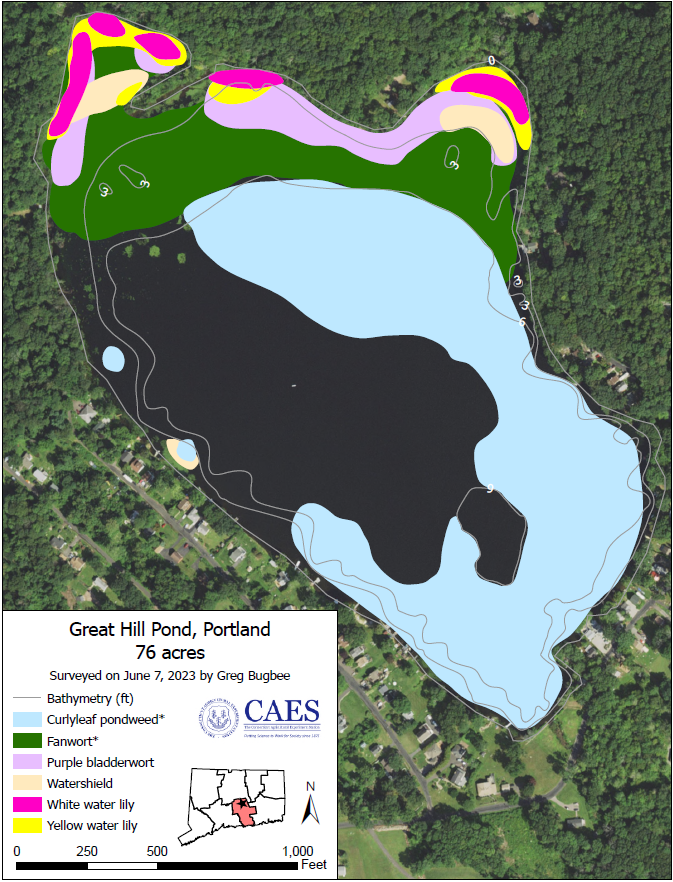
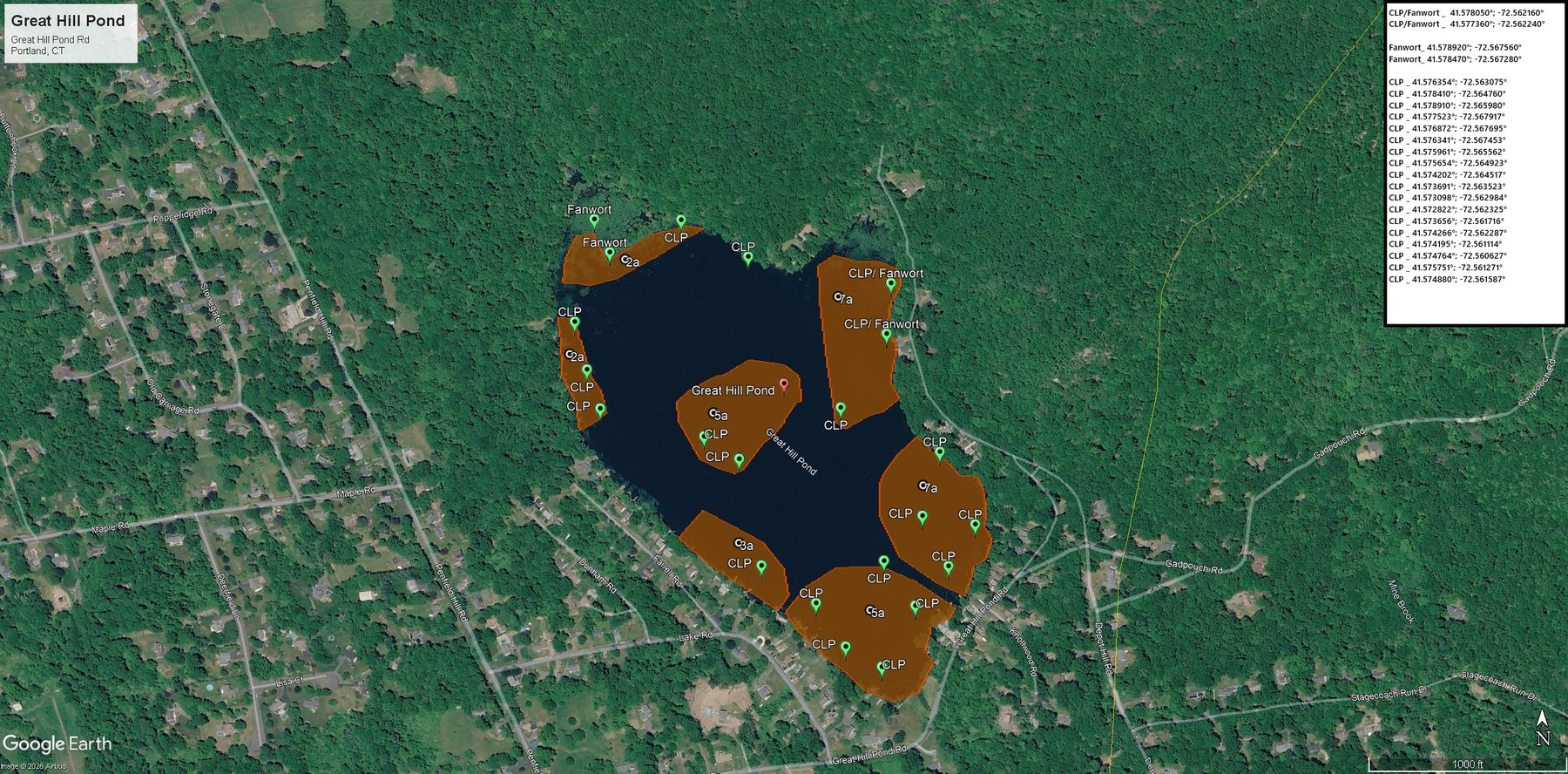
The group developed a comprehensive mitigation plan through extensive research and coordination with state agencies. We treat Curly Leaf Pondweed with diquat and Fanwort with flumioxazin, both applied under state-approved permits each season. A survey map from June 2023 documented the full extent of the affected areas, which continues to inform our treatment approach.
The organization secured Connecticut state AIS grant funding, with 75% cost reimbursement available for approved treatments. Thanks to the community's generous fundraising support and these grant reimbursements, no additional fundraising is needed for 2026. We appreciate everyone who contributed — and ask that you be prepared to help again when we plan the 2027 season.
Treatment Log
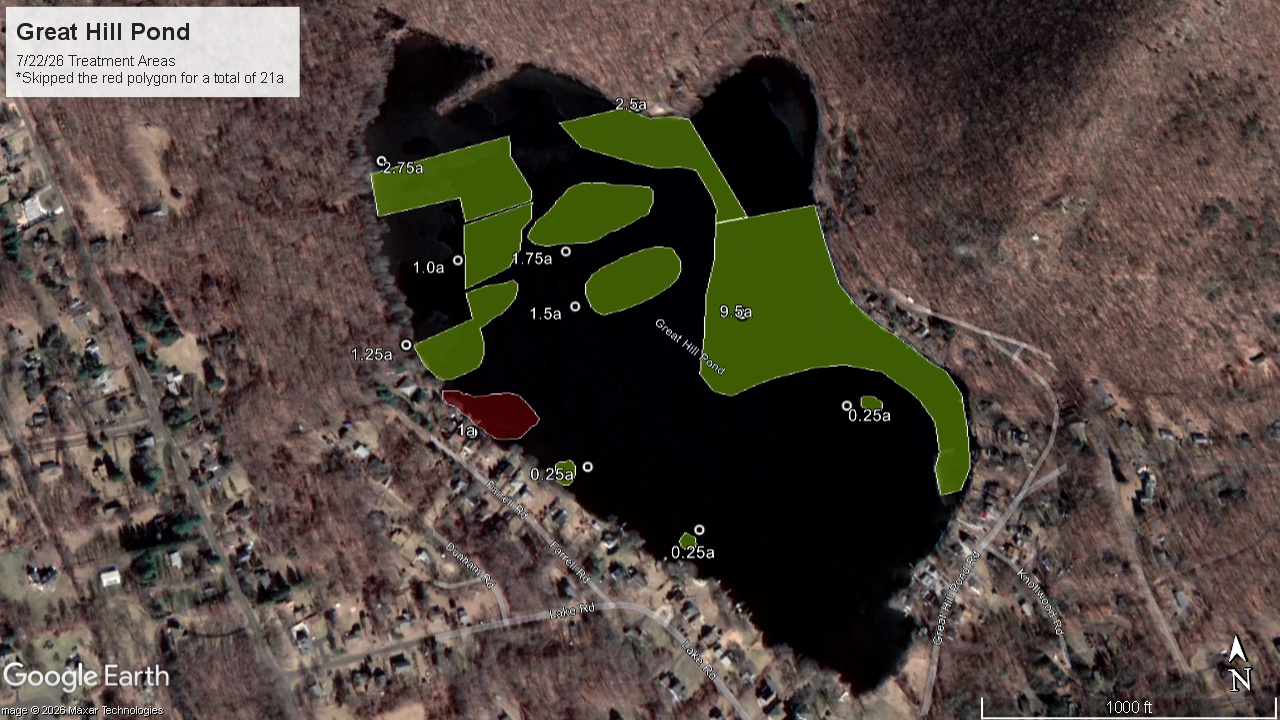
Approximately 21 acres of the Fanwort infestation were treated with flumioxazin as planned, carried out by Pond and Lake Connection. A Connecticut DEEP inspector was onsite to confirm that the boat was properly equipped to disperse herbicide according to water depth and the application rates set by the product label.
View flumioxazin details and usage guidance →
Read a summary of the CT DEEP findings →
CT DEEP investigation findings
Connecticut DEEP observed the 7/22/2026 flumioxazin (Propeller) application in person, prompted by a follow-up complaint from the same resident whose concerns led to the investigation into the 5/15/2026 treatment above. The inspector confirmed Pond and Lake Connection operated within the conditions of permit AQUA-2024-049: all applicators held active supervisory licenses, and the treatment covered 21 of the pond's 78 acres using 15 lbs 5 oz of Propeller herbicide (EPA#81927-68), an amount and method within the rates allowed by the product label. The label lists Fanwort, the target weed, under its subsurface-application table, which calls for complete coverage and sufficient contact time with submersed weeds for best results; since this treatment was applied as a surface spray, DEEP noted that its effectiveness against Fanwort specifically may be limited. The label carries no restrictions based on water depth or outflow, addressing a concern raised before the treatment. DEEP also noted that Pond and Lake's application records list applicators by initials rather than license number, and don't specify which of the mapped treatment zones make up the 21 acres actually treated, though GPS and depth-tracking records are not required to be kept.
A note from Friends of Great Hill Pond: before settling on flumioxazin (Propeller) for this treatment, the group also looked at fluridone as an option for controlling Fanwort. Fluridone was set aside as not feasible for this pond: it costs more to apply, and it works by maintaining a steady, low concentration of herbicide in the water for about a month, which a large rainfall event could wash out partway through, requiring the treatment to be redone. Fluridone is also less selective, with a greater risk of affecting plant species that were not the target of treatment.
View the full inspection narrative (PDF) →
Personal contact information has been redacted from the posted copy.
Reported 8/1 Cyanobacteria bloom and follow up →
Reported cyanobacteria bloom, 8/1/2026
On 8/1/2026, a shoreline resident reported a possible cyanobacteria bloom near their property on the pond. A news story about the report followed, and Chatham Health District said the story had misidentified the citizen's complaint as a formal DEEP communication, requesting a correction from the paper. Chatham was clear that this did not mean the report itself lacked merit, and said it would revisit the pond to check conditions.
8/3/2026: Chatham conducted visual observations at several points around the shore. No visible films, scums, mats, or other surface accumulations of cyanobacteria were seen, and the water was clear with no green opacity suggesting large amounts of cyanobacteria in the water column. Algal cell counts, toxin testing, and a public health advisory were not considered appropriate at that time.
8/7/2026: Chatham returned and took visual observations at three shoreline locations: Fire Company Beach, the Carry-In Boat Launch, and a private shoreline property near SW Lake Road. Conditions were largely clear at the first two, but some evidence of cyanobacteria (streaks and scattered clumps) was observed along the private shoreline, where Chatham had been granted access. Chatham noted that the recent herbicide treatment and resulting die-off of the targeted plants may be creating conditions more favorable to cyanobacteria, and expected the effect to be transitory rather than pond-wide.
Chatham said a broad advisory against water contact was not appropriate at this time, but recommended avoiding any water that looks solid green or blue-green throughout ("pea soup"), or any mats, films, or scums that are blue-green, look like spilled paint, or have a noxious odor, and reporting conditions like that directly to Chatham. A further visit was planned for the following week.
View the 8/3/2026 Chatham email (PDF) →
View the 8/7/2026 Chatham email (PDF) →
View the 8/7/2026 visual monitoring data sheet (PDF) →
Personal contact information has been redacted from the two posted email copies.
View the 8/7/2026 site photos (8) →
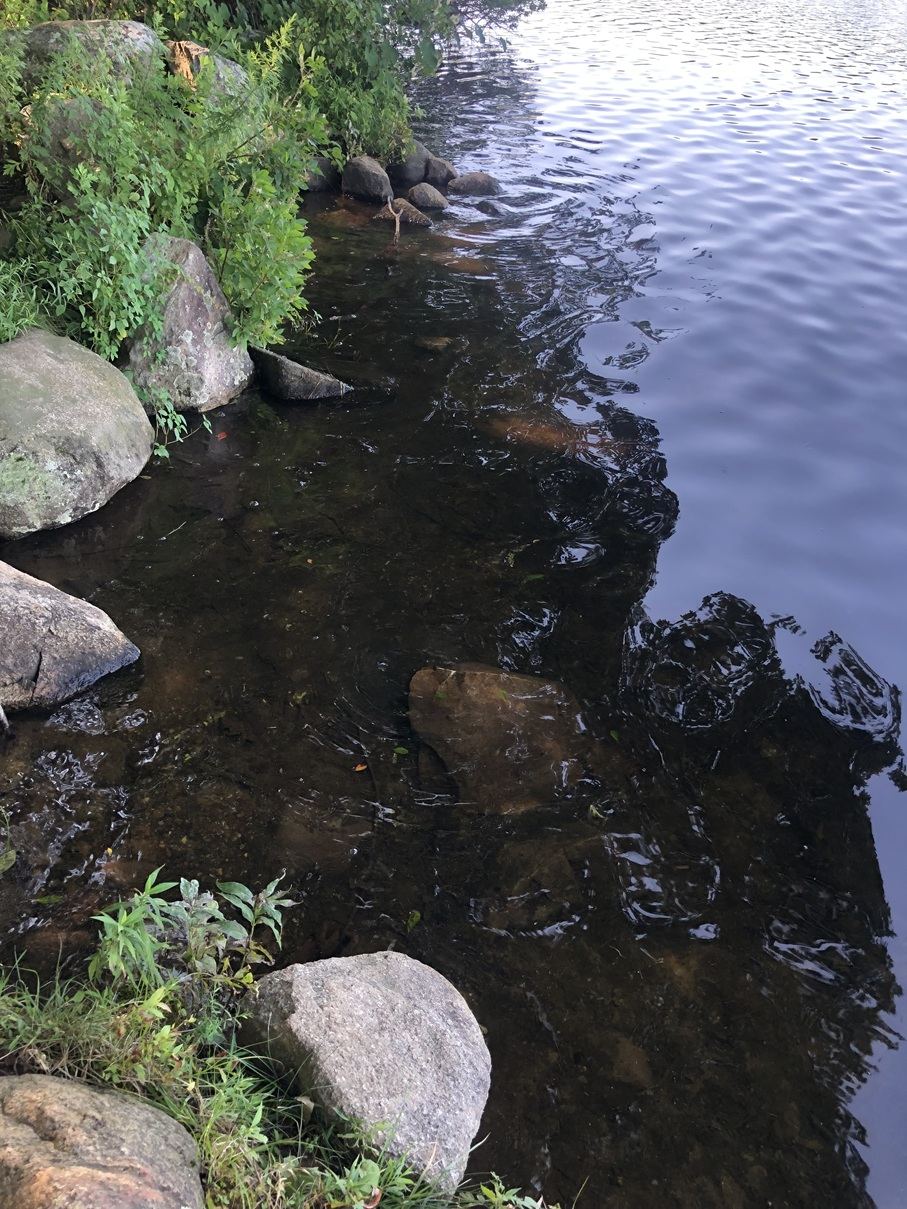
8/8/2026: A shoreline resident reported that a cyanobacteria bloom had returned along five Lake Road properties (#58, #60, #62, #64, and #68), with photos taken 8/4/2026 showing green surface scum and streaking near the shoreline and docks in that area.
View the 8/4/2026 site photos (4) →
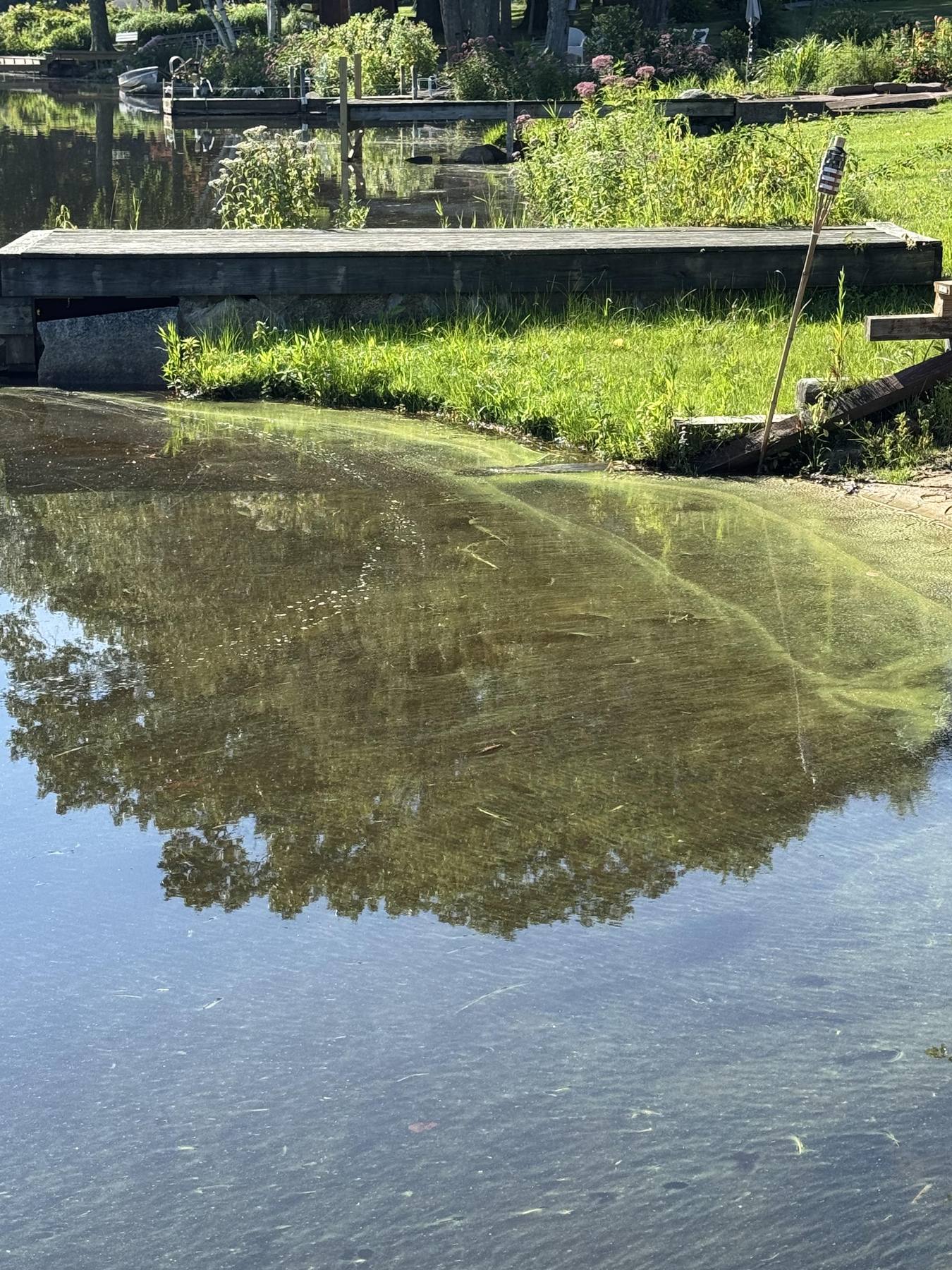
8/12/2026: Test results for a sample taken from the scum along the western shoreline on 8/7/2026 by a Lake Road resident, and sent to a lab for testing, confirmed the presence of cyanobacteria and microcystins.
View the full lab results on the Water Quality Testing page →
8/16/2026: Photos taken at the water spring on the eastern shore showed green scum and clumping on the surface.
View the 8/16/2026 eastern shore spring photos (3) →
Photos courtesy of a pond community resident.
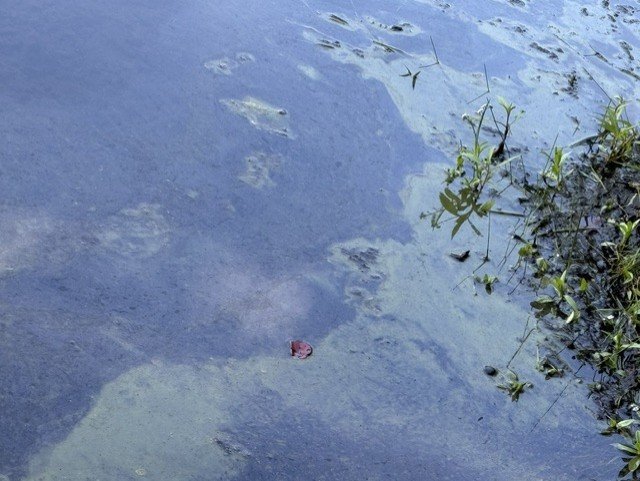
8/18/2026: Photos taken along the western shore at approximately 9:50 AM showed similar green surface scum and streaking near the shoreline, the same area sampled on 8/7/2026 where cyanobacteria and microcystins were confirmed (see 8/12/2026 above).
View the 8/18/2026 western shore photos (7) →
Photos courtesy of a pond community resident.
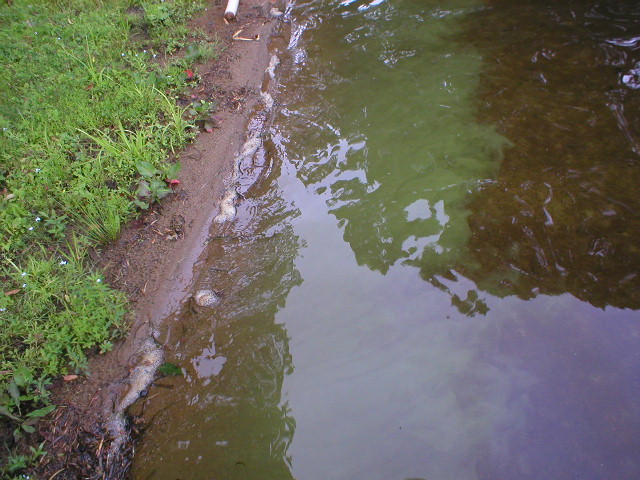
8/21/2026: Chatham Health District conducted visual monitoring at three shoreline locations (the Town of Portland's Farrell Road property, the DEEP spillway, and the DEEP Carry-In Boat Launch) and found no bloom at any of the three that morning, with water conditions largely clear. Chatham verified the regional cyanobacteria bloom reported by residents along the southern shore earlier in the week, and noted that conditions remain favorable for surface accumulations to reappear. Chatham has posted warning signs at several public access points advising against contact with dense surface accumulations or water that appears green.
View the 8/21/2026 Chatham email (PDF) →
View the 8/21/2026 visual monitoring data sheet (PDF) →
Residents separately noted the bloom actively resurfacing later that same day as the morning's rain dissipated. Surface conditions can change from day to day and even hour to hour, so a clear reading at one visit does not rule out visible accumulations later on.
8/25/2026: Residents reported that the cyanobacteria bloom was continuing.
8/30/2026: The bloom continues along the entire western shoreline. Photos below were taken between 9:00 AM and 12:00 PM.
View the 8/30/2026 site photos (26) →
Photos courtesy of a pond community resident.

9/18/2026: No further blooms have been reported, and a limnologist's visit to the pond did not find any evidence of an active bloom.
Curly Leaf Pondweed treated with diquat. Treatment costs have been reimbursed through the Connecticut AIS grant. A resident subsequently raised a concern after noticing burned grass beneath a tarp that had been in contact with pond water before the label's five-day irrigation restriction had elapsed, along with a dead bird nearby. Connecticut DEEP was notified and opened an investigation, which has since concluded.
Read a summary of the CT DEEP findings →
CT DEEP investigation findings
Connecticut DEEP found that the 5/15/2026 application was made consistent with the Tribune (diquat) product label and within the permit's limits, with 45 gallons applied across about 31 acres against a permit allowance of 60 gallons over three applications. The inspector attributed the dead patch of grass to the combination of the tarp, extreme heat, and lack of air beneath it, while noting that the tarp had been washed and the lawn watered with pond water during the label's water use restriction period. The dead bird, identified as an American Robin, was examined by UConn's Veterinary Medical Diagnostic Laboratory, which found internal bleeding and an intestinal parasite infection but no definitive cause; it tested negative for avian influenza and for anticoagulant rodenticides, and because no laboratory could be found with the capacity to test bird tissue for diquat, the cause of death remains undetermined. DEEP also found that the treatment records for the 2025 and 2026 applications did not clearly identify the junior operator's name and certification number or explain the codes used for the target species, and Pond and Lake Connection agreed to correct both on future records.
Pond and Lake Connection's response: The report also notes that a depth-prescribed application rate was not used for this treatment, with the label rate applied uniformly across the waterbody, which the inspector described as accepted common practice rather than a violation.
Pond and Lake Connection has reviewed the report and told us that they do account for water depth when applying, adjusting in real time based on sonar feedback, and that the figures quoted in the report were rough numbers they provided verbally at the time of the interview.
View the full inspection narrative (PDF) →
Personal contact information has been redacted from the posted copy.
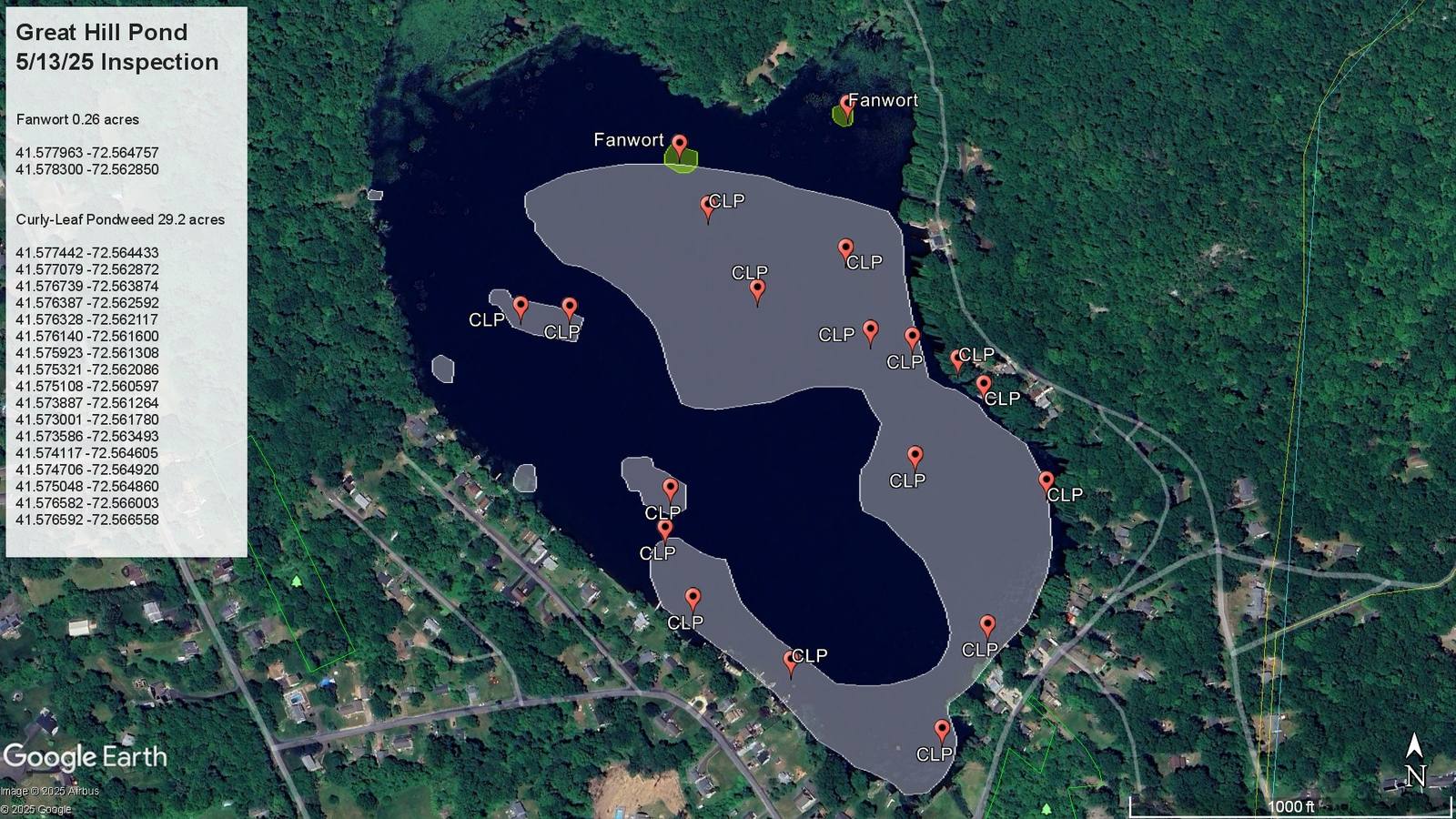
Fanwort treated across the entire infested area with flumioxazin. The high volume of vegetation die-off raised water quality concerns, including the possibility of an algal bloom; testing at the time did not confirm a dangerous presence of algae. Future Fanwort treatment strategy was adapted based on these findings.
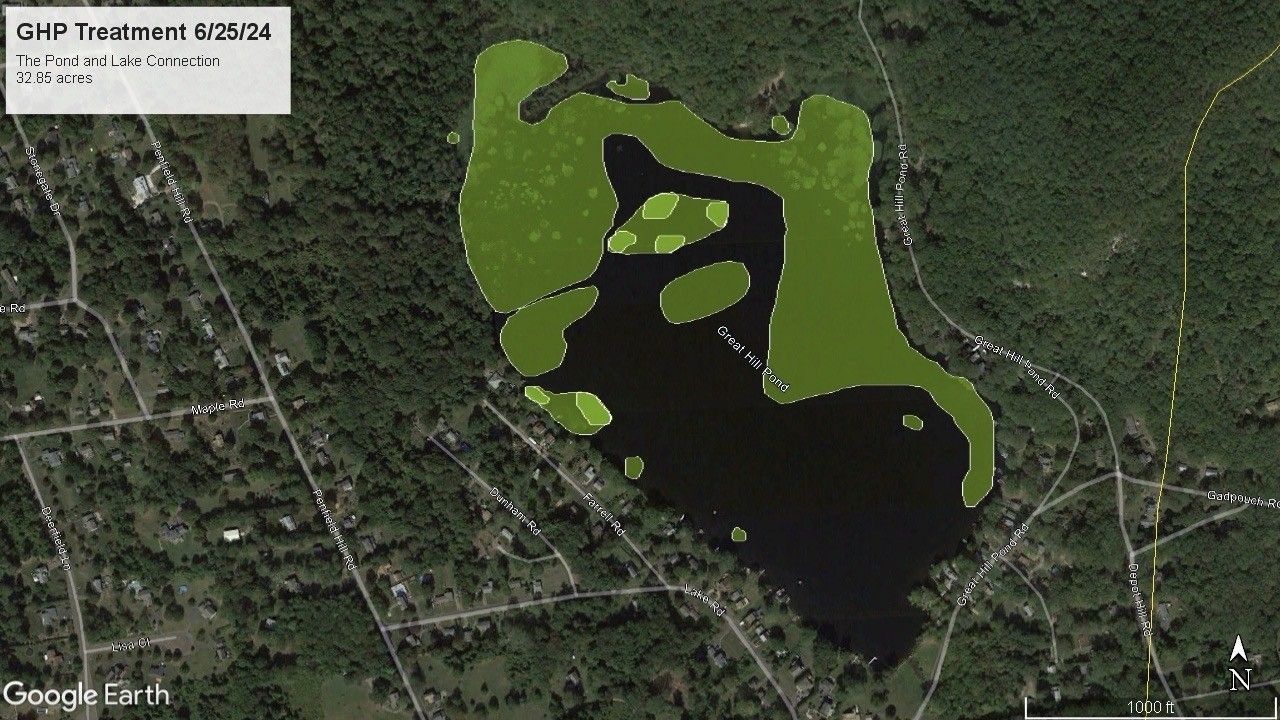
Initial treatment applications began, guided by the June 2023 survey map documenting the extent of the affected areas.
Canada Goose Management
Canada geese are an ongoing pressure on Great Hill Pond's water quality. Each bird can produce up to a pound and a half of waste per day, loading the water with the same nitrogen and phosphorus that fuel algae growth and accelerate the invasive weeds we treat every year. Managing the local goose population is a direct complement to our weed mitigation work.
We've put together a guide covering what individual property owners can do at their shorelines — starting with the most effective step of all, stopping the feeding — as well as options available to FoGHP as an organization, including egg addling and goose round-ups authorized under Connecticut law.
Canada Goose Management GuideCome Join the Working Group!
The Working Group is a team of community members who learn about and discuss important pond issues — including treatments, expenditures, fundraising, and communications — and develop consensus on how to address them. It's how our community shapes the future of the pond.
Property owners along the western shore are currently under-represented on the Working Group. We'd love to hear more voices from that part of the community.
Why join?
- Have your voice heard in the decision-making process
- Gain insight into pond management and conservation
- Meet neighbors who share your passion for the pond
We typically meet a few times in the spring to plan weed treatments and again in the summer to confirm the approach for treating Fanwort. New members are always welcome!
To join or learn more, send us a message or leave a comment on our Facebook page.